In the meantime:
Christian Morgenstern's musings on negative space..
Der Lattenzaun
Es war einmal ein Lattenzaun,
mit Zwischenraum, hindurchzuschaun.
Ein Architekt, der dieses sah,
stand eines Abends plötzlich da —
und nahm den Zwischenraum heraus
und baute draus ein großes Haus.
Der Zaun indessen stand ganz dumm,
mit Latten ohne was herum.
Ein Anblick gräßlich und gemein.
Drum zog ihn der Senat auch ein.
Der Architekt jedoch entfloh
nach Afri — od — Ameriko.
Saturday, 27 September 2008


Wednesday, 17 September 2008
subterranean lake

Hinterbrühl in southern Lower Austria is the site of the largest
subterranean lake in Europe. It was also a satellite camp of the
Mauthausen KZ and housed a gigantic underground war factory.
In 1912 a botched underground blasting operation of the local gypsum
mine caused 20 million litres of water to gush forth from behind the
rock, flooding the lower level galleries and adits, putting a definite
stop to production.

image: screenshot from www.seegrotte.at
The mine remained closed for years, only to raise from its ashes in
1932, when it opened as a tourist attraction after an international
team of cave explores ventured to make it accessible to the general
public as a show mine.

image: www.seegrotte.at

image: www.seegrotte.at
The 'Seegrotte Hinterbrühl' has been visited by more than 10 million
people. It boasts 'Austria's first Barbara-Museum', venerating St.
Barbara, the patron saint of miners. It was one of the film locations
of Disney's "The three Musketeers" (1993).
Tours are held everyday in several languages and include a 'romantic motor boat trip on the largest subterranean lake of Europe' – if navigating through a flooded former weapons factory/work camp, between the plastic waterlilies, past grotto walls lit in garishly bright colours and a pimped out gondola well fit for Lohengrin is your idea of romance, that is.

click for panorama of underground boat tour
The 'Great Lake', 60 meter underground after passing a labyrinth of tunnels and halls, has a water surface area of approx. 6200m2, and an average depth of 1.20m with the deepest point being a 12m shaft. The lake is fed by seven subterranean springs, but has no natural drain. Each night 50-60 000 liters of water are pumped to keep waterlevels at 1.20m.

image: screenshot from www.seegrotte.at
The subterranean location protected against targeted bomb raids and was consequently requisitioned for the Nationalsocialist wareffort. Under the codename "Languste" the German 'Heinkel Werke' operated an underground aircraft factory deep in the tunnels and adits that were kept dry by continous pumping.
One of many satellite camps of Mauthausen concentration camp was opened in the caverns. At first 800, then 1800 forced labourers and prisoners slaved away in 24-hour shifts, producing parts for the Me 262 jet fighter aka Schwalbe and the 'Heinkel HE 162 Salamander' aka Volksjäger, one of the first jet fighters and also one of the secret weapons of the Luftwaffe.
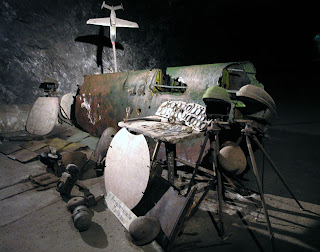
image: parts of planes produced in the underground factory exhibited in the tunnel. source.
The camp was dissolved in the last days of the war. Seven bombs were intentionally set off inside the mine, destroying the interior.
The 1800 prisoners of the camp were sent on a death march back to Mauthausen, only few survived.
About 50 prisoners remaining in the camp's hospital ward were killed by an injection of petrol because of their inability to walk.
Sources:
"Die Seegrotte und ihre verdrängte Vergangenheit als Konzentrationslager" http://no-racism.net/article/
wikipedia-article in German with info conc. a boat accident with four drowning victims in 2004: http://de.wikipedia.org/wiki/Seegrotte
http://www.geheimprojekte.at/t_hint.html
the lake grotto´s homepage www.seegrotte.at
An interview (in German) with one of the last surviving Me262 pilots of Jagdverband 44
Prisoner crates
After reading about the existence of "Wooden Imprisonment Crates" used by the US military in facilities in and around Baghdad in Vanity Fair's February 2005 issue, Russ Rick at the memory hole filed a Freedom of Information Act request with the US Central Command .
U.S.Central Command replied after more than 9 months, sending 3 black and white paper printouts of photos of the wooden cells.
The wooden crates are supposedly used to hold individual prisoners.
link: http://www.thememoryhole.org/2008/07/prisoner-boxes-in-iraq/
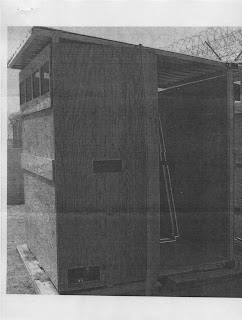
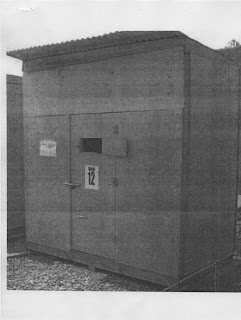
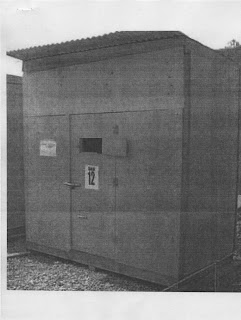
screenshot of images obtained and published by Russ Rick 23.7.2008
Bryan Finoki at subtopia comments on the use of confined space as an instrument of torture in this article.
Other articles of special interest at subtopia:
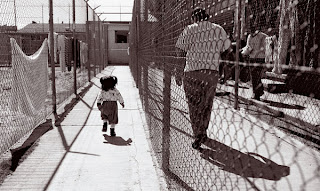
Carceral Wombs, links to a photo essay (image source) by journalist Charles Bowden and Penny De Los Santos on incarcerated women and their children at Laredo Penitentiary.
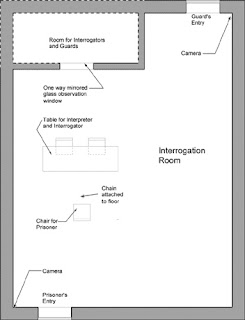
Torture Space: Architecture in Black
image: Architecure of detention, article at salon.
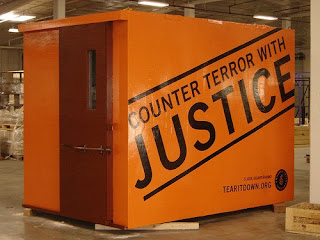
Shipping Justice
image: The Guantanamo Cell Tour on Flickr. Scaled replica of a maximum security prison cell at Guantanamo Bay 10x6x8 ft scaled replica of maximum security prison cell at Guantanamo Bay, part of Amnesty International’s Counter Terror with Justice campaign.
U.S.Central Command replied after more than 9 months, sending 3 black and white paper printouts of photos of the wooden cells.
The wooden crates are supposedly used to hold individual prisoners.
link: http://www.thememoryhole.org/


screenshot of images obtained and published by Russ Rick 23.7.2008
Bryan Finoki at subtopia comments on the use of confined space as an instrument of torture in this article.
Other articles of special interest at subtopia:
Carceral Wombs, links to a photo essay (image source) by journalist Charles Bowden and Penny De Los Santos on incarcerated women and their children at Laredo Penitentiary.
Torture Space: Architecture in Black
image: Architecure of detention, article at salon.
Shipping Justice
image: The Guantanamo Cell Tour on Flickr. Scaled replica of a maximum security prison cell at Guantanamo Bay 10x6x8 ft scaled replica of maximum security prison cell at Guantanamo Bay, part of Amnesty International’s Counter Terror with Justice campaign.
This is your brain on space..
Beauty and the Brain, an article in the latest issue of SEED magazine (October 2008) treats the subject of the emerging field of neuroaesthetics. Recent work by researchers at the University College of London and the establishment of the first major grant-driven research program for the neurobiological investigation of aesthetics have contributed to a first approximation towards a unified biocultural theory of art.
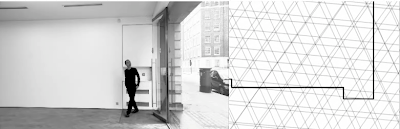
images: screenshots from the installation film at the Neurotopographics website
Neuroscientist Hugo Spiers` work at UCL is concerned with the brain´s encoding of direction, location and dimensions of space.
Quote from the article by Moheb Costandi:
”As for architecture, altering space can have a large impact on brain function. Changing the dimensions of an animal´s enclosure causes grid cells to alter their scales accordingly, such that the periodicity of their firing, which is observed as the animal moves across a space, increases or decreases. Surprisingly, negotiating a corridor in opposite directions elicits completely different patterns of place-cell activity, so the same space is apparently encoded as two different places. A less surprising but still important finding is that the lack of easily recognizable landmarks causes disorientation. Spiers and his colleagues are now investigating how the brain encodes three-dimensional space. While recording neuronal activity as rats negotiated a spiral staircase, they found that place cells, but not grid cells, respond to changes in height. Thus, the brain seems to encode the vertical and horizontal dimensions in different ways.”
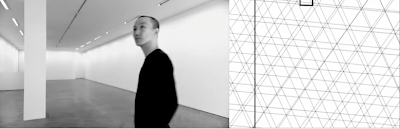
images: screenshots from the installation film at the Neurotopographics website
New knowledge of spatial cognition and the understanding of the neural bases of spatial perception can then inform architects and designers on the brain´s response to the built environment and assist in organising space in a meaningful way.
In a recent project, funded by the Wellcome Trust his collaboration with architect Bettina Vismann and artist Antoni Malinowski produced an installation called Neurotopographics, tracking the relationship between movement through space and the respective activities of the brain.

images: screenshots from the installation film at the Neurotopographics website

images: screenshots from the installation film at the Neurotopographics website
Neuroscientist Hugo Spiers` work at UCL is concerned with the brain´s encoding of direction, location and dimensions of space.
Quote from the article by Moheb Costandi:
”As for architecture, altering space can have a large impact on brain function. Changing the dimensions of an animal´s enclosure causes grid cells to alter their scales accordingly, such that the periodicity of their firing, which is observed as the animal moves across a space, increases or decreases. Surprisingly, negotiating a corridor in opposite directions elicits completely different patterns of place-cell activity, so the same space is apparently encoded as two different places. A less surprising but still important finding is that the lack of easily recognizable landmarks causes disorientation. Spiers and his colleagues are now investigating how the brain encodes three-dimensional space. While recording neuronal activity as rats negotiated a spiral staircase, they found that place cells, but not grid cells, respond to changes in height. Thus, the brain seems to encode the vertical and horizontal dimensions in different ways.”

images: screenshots from the installation film at the Neurotopographics website
New knowledge of spatial cognition and the understanding of the neural bases of spatial perception can then inform architects and designers on the brain´s response to the built environment and assist in organising space in a meaningful way.
In a recent project, funded by the Wellcome Trust his collaboration with architect Bettina Vismann and artist Antoni Malinowski produced an installation called Neurotopographics, tracking the relationship between movement through space and the respective activities of the brain.

images: screenshots from the installation film at the Neurotopographics website
Monday, 15 September 2008
"What a curious feeling! I must be shutting up like a telescope."

ALICE-IN-WONDERLAND-Syndrome
named after the novel by Lewis Carroll.
A disorienting neurological condition affecting human perception,
first described in 1955 by English psychiatrist John Todd (1914-1987).
Aso known as Lilliputian hallucination and Todd's syndrome.
Sufferers experience distortions of space, time and body image, visual
hallucinations, micropsia or macropsia. The entire body or parts of it
are experienced as altered in shape and size.
A temporary condition, it is often associated with migraines, brain
tumours, and the use of psychoactive drugs.
A description of the syndrome as experienced by a 31 y.o. Brit in a Guardian article.
container

image: Per-Oskar Leu
Reduce, Reuse, Recycle
2006
174x286x166cm
Sealed garbage skip built by inmates in Trondheim Prison, Norway.
"For his graduation project Reduce, Reuse, Recycle (2006), [Per-Oskar] Leu hired inmates in a Norwegian prison to build a "Trojan Horse" in the shape of a hermetically sealed garbage container. By capturing a piece of confined space and transporting it out of the correctional institution, the artist alluded to the idea of escape while examining the prison economy and issues of forced labour."
Leu´s show "Like A Dog" is currently on at UKS, Norway.
Monday, 1 September 2008
work & play

image: fancamp vienna
Accomodation for football fans during the EURO2008 in Vienna, Austria.
A 16.000 sqm hall converted into a hostel with over 500 booths, housing two bunkbeds each at €38 per night. For security reasons the plywood booths have no ceiling, cannot be locked and the light in the hall is constantly on.

image: Playtime,movie still, directed by Jacques Tati, 1967.
Sunday, 31 August 2008
An alphabetical list of phobias relating to general experience of space

image: Arne B. Langleite
A-
Achluophobia- Fear of darkness.
Acrophobia- Fear of heights.
Aeroacrophobia- Fear of open high places.
Agoraphobia- Fear of open spaces or of being in crowded, public places like markets. Fear of leaving a safe place.
Agyrophobia- Fear of streets or crossing the street.
Altophobia- Fear of heights.
Amaxophobia- Fear of riding in a car.
Ambulophobia- Fear of walking.
Anablephobia- Fear of looking up.
Anemophobia- Fear of air drafts or wind.(Ancraophobia)
Apeirophobia- Fear of infinity.
Aphenphosmphobia- Fear of being touched. (Haphephobia)
Astrophobia- Fear of stars or celestial space.
Asymmetriphobia- Fear of asymmetrical things.
Ataxophobia- Fear of disorder or untidiness.
Atephobia- Fear of ruin or ruins.
Auroraphobia- Fear of Northern lights.
Autophobia- Fear of being alone or of oneself.
Aviophobia or Aviatophobia- Fear of flying.
B-
Barophobia- Fear of gravity.
Basophobia or Basiphobia- Inability to stand. Fear of walking or falling.
Bathmophobia- Fear of stairs or steep slopes.
Bathophobia- Fear of depth.
Batophobia- Fear of heights or being close to high buildings.
C-
Catapedaphobia- Fear of jumping from high and low places.
Cathisophobia- Fear of sitting.
Catoptrophobia- Fear of mirrors.
Chorophobia- Fear of dancing.
Chronophobia- Fear of time.
Claustrophobia- Fear of confined spaces.
Cleithrophobia or Cleisiophobia- Fear of being locked in an enclosed place.
Climacophobia- Fear of stairs, climbing, or of falling downstairs.
Clinophobia- Fear of going to bed.
Clithrophobia or Cleithrophobia- Fear of being enclosed.
Coimetrophobia- Fear of cemeteries.
Cremnophobia- Fear of precipices.
Cymophobia or Kymophobia- Fear of waves or wave like motions.
D-
emophobia- Fear of crowds. (Agoraphobia)
Dendrophobia- Fear of trees.
Dextrophobia- Fear of objects at the right side of the body.
Didaskaleinophobia- Fear of going to school.
Dinophobia- Fear of dizziness or whirlpools.
Dishabiliophobia- Fear of undressing in front of someone.
Domatophobia- Fear of houses or being in a house.(Eicophobia, Oikophobia)
Dromophobia- Fear of crossing streets.
E-
Ecclesiophobia- Fear of church.
Ecophobia- Fear of home.
Eicophobia- Fear of home surroundings.(Domatophobia, Oikophobia)
Eisoptrophobia- Fear of mirrors or of seeing oneself in a mirror.
Eleutherophobia- Fear of freedom.
Enochlophobia- Fear of crowds.
Eosophobia- Fear of dawn or daylight.
Epistemophobia- Fear of knowledge.
Eremophobia- Fear of being oneself or of lonliness.
G-
Gephyrophobia or Gephydrophobia or Gephysrophobia- Fear of crossing bridges.
H-
Hadephobia- Fear of hell.
Heliophobia- Fear of the sun.
Hodophobia- Fear of road travel.
Homichlophobia- Fear of fog.
Hylophobia- Fear of forests.
Hypsiphobia- Fear of height.
I-
Illyngophobia- Fear of vertigo or feeling dizzy when looking down.
Isolophobia- Fear of solitude, being alone.
K-
Kathisophobia- Fear of sitting down.
Kenophobia- Fear of voids or empty spaces.
Kinetophobia or Kinesophobia- Fear of movement or motion.
Koinoniphobia- Fear of rooms.
Kosmikophobia- Fear of cosmic phenomenon.
Kymophobia- Fear of waves. (Cymophobia)
L-
Levophobia- Fear of things to the left side of the body.
Limnophobia- Fear of lakes.
Lygophobia- Fear of darkness.
M-
Megalophobia- Fear of large things.
Merinthophobia- Fear of being bound or tied up.
Microphobia- Fear of small things.
Mnemophobia- Fear of memories.
Monophobia- Fear of solitude or being alone.
Myctophobia- Fear of darkness.
N-
Nebulaphobia- Fear of fog. (Homichlophobia)
Nephophobia- Fear of clouds.
Nostophobia- Fear of returning home.
Nyctohylophobia- Fear of dark wooded areas or of forests at night
Nyctophobia- Fear of the dark or of night.
O-
Ochlophobia- Fear of crowds or mobs.
Ochophobia- Fear of vehicles.
Oikophobia- Fear of home surroundings, house.(Domatophobia, Eicophobia)
Optophobia- Fear of opening one's eyes.
Ouranophobia or Uranophobia- Fear of heaven.
P-
Phengophobia- Fear of daylight or sunshine.
Photophobia- Fear of light.
Pluviophobia- Fear of rain or of being rained on.
Pteromerhanophobia- Fear of flying.
S-
Sciophobia Sciaphobia- Fear of shadows.
Scolionophobia- Fear of school.
Scopophobia or Scoptophobia- Fear of being seen or stared at.
Scotomaphobia- Fear of blindness in visual field.
Scotophobia- Fear of darkness. (Achluophobia)
Scriptophobia- Fear of writing in public.
Selenophobia- Fear of the moon.
Siderodromophobia- Fear of trains, railroads or train travel.
Siderophobia- Fear of stars.
Sinistrophobia- Fear of things to the left or left-handed.
Spacephobia- Fear of outer space.
Stasibasiphobia or Stasiphobia- Fear of standing or walking. (Ambulophobia)
Stenophobia- Fear of narrow things or places.
Stygiophobia or Stigiophobia- Fear of hell.
T-
Taphephobia Taphophobia- Fear of being buried alive or of cemeteries.
Thaasophobia- Fear of sitting.
Thalassophobia- Fear of the sea.
Topophobia- Fear of certain places or situations, such as stage fright.
Tropophobia- Fear of moving or making changes.
U-
Uranophobia or Ouranophobia- Fear of heaven.
X-
Xylophobia- 1) Fear of wooden objects. 2) Forests.
(culled from The Phobia List)

Subscribe to:
Posts (Atom)